
Description
Neal Martin describes Adi Badenhorst as someone who “epitomises the carefree spirit that pervades the [Swartland] region”, a phrase that still doesn’t do justice to a man whose personality is as characterful as the wines he makes. Founding A.A. Badenhorst Family Wines in the Paardeberg with his cousin Hein in 2008, Adi champions attentive farming and minimal intervention winemaking to convey an authentic expression of the Swartland in his wines.
Adi grew up on a wine farm in Constantia and made his first wine at thirteen. After studying oenology at Elsenberg, he worked harvests at Château Angelus and Alain Graillot, before returning to South Africa. Following nine years as winemaker at the Rustenburg Estate in Stellenbosch, Adi was captivated by a run-down farm on the northern side of the Swartland’s Paardeberg Mountain. “The mountain has texture and slopes. You know those grapes can make interesting wines”, he explains. Today, that old farm forms Kalmoesfontein, where A.A. Badenhorst are based.
Set within a natural amphitheatre, the Kalmoesfontein farm is home to exceptional parcels of old, bush vine Chenin Blanc, Cinsault and Grenache, planted on north, east, and south-facing slopes between the 1950s and 1970s. The vines’ age and various exposures bring further variety and depth to the fruit. The Paardeberg’s soils, which comprise decomposed granite, quartz and iron-rich ‘koffieklip’ (ferricrete), are also central to the character of A.A. Badenhorst’s wines. Over 500 million years old, the soil’s top layer has a sandy texture, allowing the vines to root deep into the ground, resulting in remarkably fragrant wines.
A.A. Badenhorst’s approach to viticulture is simple and hands-on: The better you know your vines, the less work is needed to get the best from them. The team farms the vines sensitively, with composting, cover crops, mulching and avoiding herbicides to enrich the soil and preserve the character of each site. They continue to replant and work with around 70 different cultivars across Kalmoesfontein and Jakkalsfontein, the neighbouring farm purchased in 2021.
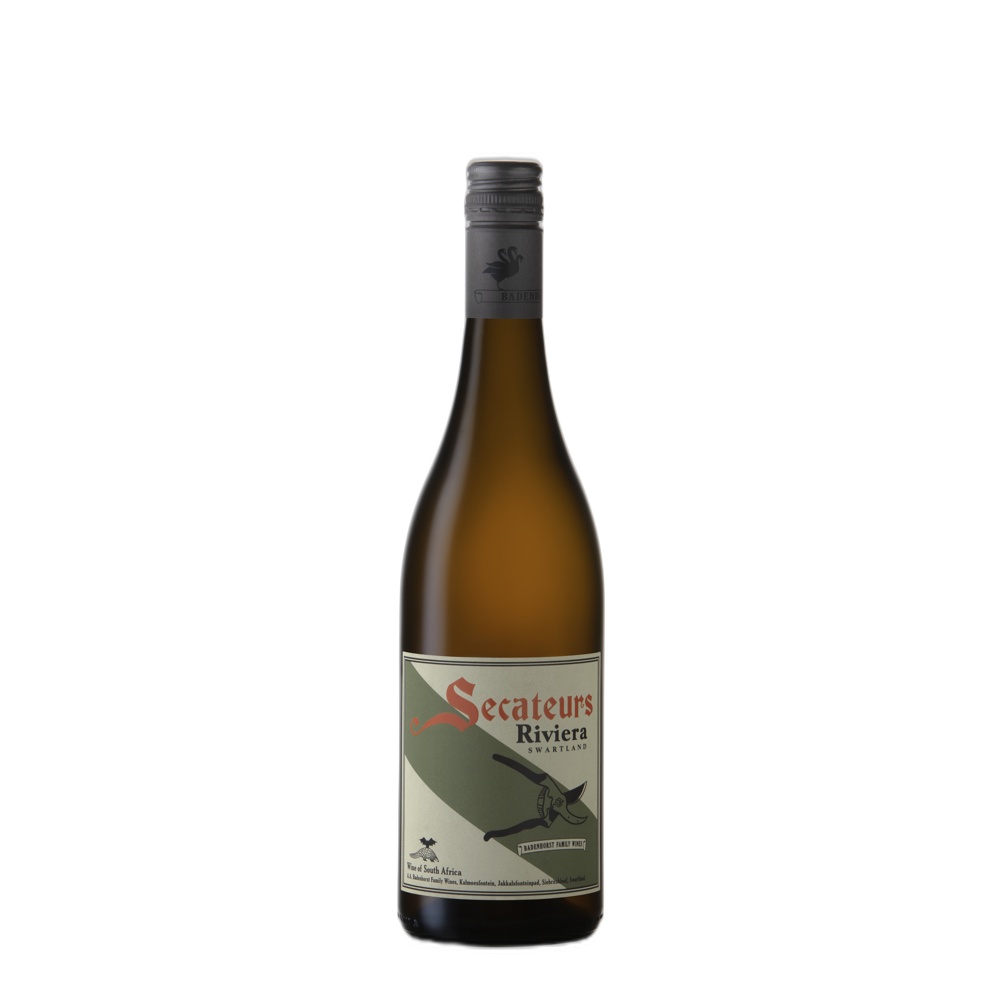
The fruit for Secateurs Riviera comes from a single old Chenin Blanc vineyard, planted in 1972, located beside a dry riverbed in the Swartland. Affectionately named “Riviera,” the site features sandy decomposed granite soils, which contribute to the wine’s mineral lift and aromatic clarity. Grapes are picked when tannins are ripe and the fruit has turned golden yellow under the Swartland sun, ensuring depth and texture.
A complex aromatic profile with notes of grapefruit, quince, and spice. The palate is grippy and textured, supported by a refreshing tannin structure. The wine’s deeper yellow hue reflects its skin contact and maceration, offering a distinctive and expressive take on Swartland Chenin Blanc.